Willson, T.M., Cobb, J.E., Cowan, D.J., et al. The structure-activity relationship between peroxisome proliferator-activated receptor γ agonism and the antihyperglycemic activity of thiazolidinediones. J Med Chem39665-668(1996).
Lehmann, J.M., Moore, L.B., Smith-Oliver, T.A., et al. An antidiabetic thiazolidinedione is a high affinity ligand for peroxisome proliferator-acivated receptor γ (PPARγ). J Biol Chem27012953-12956(1995).
Kodera, Y., Takeyama, K., Murayama, A., et al. Ligand type-specific interactions of peroxisome proliferator-activated receptor γ with transcriptional coactivators. J Biol Chem27533201-33204(2000).
Cantello, B.C.C., Cawthorne, M.A., Cottam, G.P., et al. [[ω-(Heterocyclylamino)alkoxy]benzyl]-2,4-thiazolidinediones as potent antihyperglycemic agents. J Med Chem373977-3985(1994).
Tchoukalova, Y.D., Hausman, D.B., Dean, R.G., et al. Enhancing effect of troglitazone on porcine adipocyte differentiation in primary culture: a comparison with dexamethasone. Obes Res8(9)664-672(2000).
Yoshizawa, K., Cioca, D.P., Kawa, S., et al. Peroxisome proliferator-activated receptor γ ligand troglitazone induces cell cycle arrest and apoptosis of hepatocellular carcinoma cell lines. Cancer95(10)2243-2251(2002).
Willson, T.M., Brown, P.J., Sternbach, D.D., et al. The PPARs: From orphan receptors to drug discovery. J Med Chem43(4)528-550(2000).
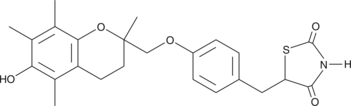
Troglitazone is a TZD which was approved for the treatment of insulin resistance and hyperglycemia in Type II diabetes, under the trade name Resulin™, but was withdrawn from the market due to hepatotoxicity. Troglitazone is a potent and selective PPARγ agonist. The EC50 values for transactivation of human and mouse PPARγ in a cell-based assay are 0.55 and 0.78 µM, respectively.1 In the same assay system, no activation of PPARα and PPARδ was observed at concentrations up to 10 µM. Troglitazone binds to the PPARγ ligand-binding domain (LBD) but fails to induce interaction of the PPARγ LBD with the transcriptional coactivators SRC-1, TIF2, AIB1, p300, or TRAP220.2 Troglitazone also induces cell cycle arrest and apoptosis in several cancer cell lines with an EC50 of 10 µM.3
1
Willson, T.M., Brown, P.J., Sternbach, D.D., et al. The PPARs: From orphan receptors to drug discovery. J Med Chem43(4)528-550(2000).
2
Kodera, Y., Takeyama, K., Murayama, A., et al. Ligand type-specific interactions of peroxisome proliferator-activated receptor γ with transcriptional coactivators. J Biol Chem27533201-33204(2000).
3
Yoshizawa, K., Cioca, D.P., Kawa, S., et al. Peroxisome proliferator-activated receptor γ ligand troglitazone induces cell cycle arrest and apoptosis of hepatocellular carcinoma cell lines. Cancer95(10)2243-2251(2002).